
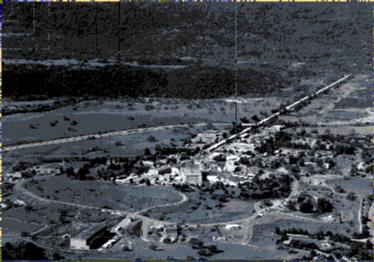
 It
is located on 425 acres of Stanford property west of the main campus, on
Sand Hill Road. Stanford University operates SLAC under a contract with
the US Department of Energy. Established in 1962, SLAC has become a world-renowned
elementary particle physics laboratory, recognized for more than four decades
of acheivement in the field. Some of the highlights of SLAC’s distinguished
history are shown in the timeline.
It
is located on 425 acres of Stanford property west of the main campus, on
Sand Hill Road. Stanford University operates SLAC under a contract with
the US Department of Energy. Established in 1962, SLAC has become a world-renowned
elementary particle physics laboratory, recognized for more than four decades
of acheivement in the field. Some of the highlights of SLAC’s distinguished
history are shown in the timeline.
From the beginning, a “switchyard” of magnetic elements at the end of
the accelerator could direct the beams to any of several different experimental
areas. These included bubble and streamer chambers and a variety of particle
spectrometers. The large spectrometers in End Station A were used in the
late 1960s and early 1970s in a series of electron-proton and electron-neutron
scattering experiments that demonstrated the existence of quarks inside
the nucleon.
Professor Richard Taylor, the leader of the SLAC team, shared the 1990
Nobel Prize in Physics for his part in this work. In addition to primary
beams of electrons and positrons, secondary beams of pions, kaons, muons
and photons were also produced and used in a variety of other experiments.
With the advent of colliding beam storage rings (SPEAR in 1972) and
PEP (in 1980), which are discussed in more detail below, the SLAC linac
also served as source and injector for electrons and positrons.
Starting in 1983, extensive modifications and additions to the existing
linac enabled it to simultaneously accelerate and collide 50 GeV electrons
and positron bunches on a pulse-to-pulse basis. This new machine, the SLAC
Linear Collider or SLC, separated the beams at the end of the accelerator,
guiding them through two opposing magnetic arcs and focusing them on each
other, to micron-size spots at just the correct center-of-mass collision
energy (~ 92 GeV) to produce the Z 0 particle, the neutral mediator of
the weak interaction. Physics at the SLC started in 1988 with the Mark
II detector, replaced in 1991 by the SLD (SLAC Large Detector), a more
modern instrument. In 1992, the SLC was first operated with polarized electrons,
an innovation that opened a new area of precision physics measurements.
Between 1992 and 1996, a series of improvements to the accelerator steadily
increased the luminosity of the SLC and brought the electron polarization
to an average of 78%. In 1996, the SLD was equipped with a new vertex detector
(VX D3) which greatly enhanced its physics capability. In the 1997–1998
run, the SLD logged in excess of 300,000 Zs. Operation of the two-mile
linac in the SLC mode has also greatly enhanced its performance for more
recent stationary target electron scattering
experiments with polarized electrons in End Station A. Other innovative
experiments have been performed in the straight-ahead Final Focus
Test Beam where tiny electron bunches with full heights of 120 nanometers
have been measured. With all these contributions and innovations, the SLC
is the pioneering embodiment of a new colliding-beam technique that continues
SLAC’s leading role in developing the next generation
electron-positron collider. Such a collider, capable of producing TeV-scale
center-of-mass energies, is now under design.
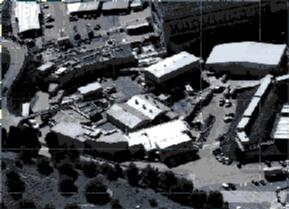 .
The SPEAR facility was used in the discovery of the psi particle, for which
Professor Burton Richter, current Director of SLAC, shared the Nobel Prize
in 1976. It was also used in the discovery of the tau lepton, for which
Professor Martin Perl shared the 1982 Wolfe Prize and the 1995 Nobel Prize.
In late 1990, SPEAR’s operation was transferred to the Stanford Synchrotron
Radiation Laboratory (SSRL) for dedicated use in synchrotron radiation
research. In 1992, SSRL became a division of SLAC. The SPEAR storage ring
now has its own electron injector (linac and synchrotron booster).
.
The SPEAR facility was used in the discovery of the psi particle, for which
Professor Burton Richter, current Director of SLAC, shared the Nobel Prize
in 1976. It was also used in the discovery of the tau lepton, for which
Professor Martin Perl shared the 1982 Wolfe Prize and the 1995 Nobel Prize.
In late 1990, SPEAR’s operation was transferred to the Stanford Synchrotron
Radiation Laboratory (SSRL) for dedicated use in synchrotron radiation
research. In 1992, SSRL became a division of SLAC. The SPEAR storage ring
now has its own electron injector (linac and synchrotron booster).
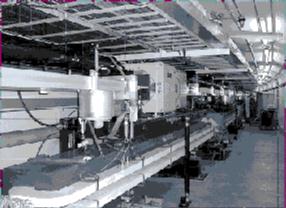 The
facility supported the research of over 300 physicists from around the
globe until about 1990. In 1994, construction of a new machine called PEP-II
began in the original PEP tunnel. The purpose of PEP-II is to serve as
a B Factory where an unprecedented number of B mesons will be produced
to study CP violation. While in PEP-I the electron and positron beams were
stored at equal energies in a single ring, PEP-II is equipped with a high-energy
ring (HER) for electrons at an energy of 9.1 GeV and a low energy ring
(LER) for positrons of 3 GeV. The center-of-mass colliding energy will
be about 10.5 GeV. Colliding electrons and positrons at different energies
to boost the motion of the center-of-mass and separating the vertices of
the decaying B mesons constitutes another major innovation executed by
SLAC in collaboration with LBNL and LLNL.
The
facility supported the research of over 300 physicists from around the
globe until about 1990. In 1994, construction of a new machine called PEP-II
began in the original PEP tunnel. The purpose of PEP-II is to serve as
a B Factory where an unprecedented number of B mesons will be produced
to study CP violation. While in PEP-I the electron and positron beams were
stored at equal energies in a single ring, PEP-II is equipped with a high-energy
ring (HER) for electrons at an energy of 9.1 GeV and a low energy ring
(LER) for positrons of 3 GeV. The center-of-mass colliding energy will
be about 10.5 GeV. Colliding electrons and positrons at different energies
to boost the motion of the center-of-mass and separating the vertices of
the decaying B mesons constitutes another major innovation executed by
SLAC in collaboration with LBNL and LLNL.